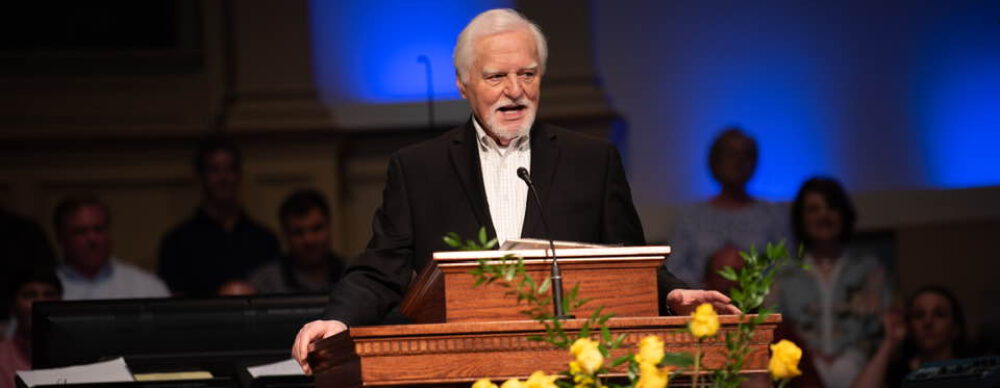
The pastor’s in trouble, so he prays. (Good idea!)

Nothing jerks our prayers out of the “blessed generality” stage like a crisis. The best kind of crisis for that is for a close loved one to get in serious trouble–car wreck, cancer, emergency surgery, that sort of thing.

But a close second is a personal crisis, the kind where someone is making life miserable for you and it’s taking all the reserves you can muster to get out of bed in the morning and walk into one more day. You either quit praying altogether, the worst possible choice, or your prayers lose their vain repetitions and meaningless phrases and get down to business.

Yesterday, going through a stack of notes from the 1990s, I found such a prayer of mine, written in the thick of church conflict. It’s undated, so there’s no way of determining what particular struggle was going on then. We went through so many, the first six or seven years of my 14-year pastorate at the last church we served.

The prayer was written in longhand and filled two pages. It’s about as specific as one would want a prayer to be. No more “bless him” and “help her.” But on the other hand, it does not call names and I’m glad to report, it’s not as harsh as some of the Psalms where David or whoever is praying for the children of his enemies to not live to see that day’s sunset.

Here is the prayer, along with a few comments. I send it forth in the hope that some servant of the Lord in the fight of his life may find encouragement to hang tough and be faithful.

Father, what I’m praying for is that….

1) Everything I preach may come from thee. Lead me please regarding subjects, texts, stories, applications, and especially in the delivery.”

When people are fighting the pastor, invariably they attack his sermons.  The critics are hitting us where we are most vulnerable, because few of us feel that our preaching is all it should be. They will find fault with what you are preaching, the scriptures you use, the stories you tell, the way you say it, everything. If you are doing all things well, they will criticize your tie–or the lack of one.

The remedy is to turn their opposition into motivation to pray harder, study more diligently, and do everything you know in order to preach the sharpest, most powerful sermons you’re capable of doing.

Continue reading

Encouraging the young, struggling pastor

It is good for a man to bear the yoke in his youth. (Lamentations 3:27). 

Dear Young Pastor:

I hear you’re having a tough time of it.

Good. Glad to hear it.

As I got it, a group in the church doesn’t care for your leadership. They find fault with your sermons. They probably don’t like the color of your tie (or worse, the fact that you don’t wear one).

What makes their opposition dire is that they are the leaders of the church. Not a good thing.

Unity is always better than division.

You came close to resigning, I’m told. You probably felt, “If I don’t have the support of these elected leaders of the church, then I’ll not be able to do anything here.”

You actually wrote out a resignation, perhaps to see what it would feel like.

It felt wrong. You knew you were displeasing the One who sent you there in the first place.

So, you chose to hang in there and try to give leadership to a church that is not sure it wants any.

Welcome to the ministry.

Continue reading

12 things pastors should do promptly–and several they shouldn’t

Do these things promptly…

    1. Confess sins.  “Keep short accounts with God,” it’s called.
    2. Write thank you notes. Even two sentences.  Oh, and hand-write them, rather than dictating them for someone to type.  The personal touch is good.
    3. Write notes of appreciation.  “Great song Sunday.”  “I hear excellent things about your class.” My suggestion is you should begin every Monday morning in the office by handwriting five notes.
    4. When inspiration for a sermon or an article comes in the middle of the night, it must be recorded then or, count on it, you’ll never remember it.  Keep a pad by the bedside. Or, do what I do: get up and go into the breakfast room and pull up a chair and write everything out.
    5. When you agree to do a friend  a favor–write a letter of recommendation, call on a patient in a hospital, whatever–do it immediately or you will never do it. As a cartoonist, I try to do the same when asked to illustrate someone’s writing.
    6. Jot down a story, illustration, or thought for a sermon that occurs to you.  If you’re in the car alone, look for an exit and get off the highway so you can write this down.  I’ve sometimes asked my wife to make a note for me as we drove.
    7. Pray for someone when prompted by the Spirit.  When I spot someone who reminds me of a person I knew years ago, I take that as an impulse to pray for them.

And these also–

  1. Pray for someone when you are asked to pray.  Stop right then and do it
  2. Forgiving offenses.  Whether they ask for it or not.
  3. Tell your wife how lovely she looks.  Don’t wait for her to ask if that dress looks all right.  Every time you think of it, tell her she is lovely.
  4. Give your kids a hug.  Let them know how special they are to you, with no condition or strings attached.
  5. Worship God.  In your spirit, in a few words.  If  possible, say it out loud.

But do not do these things promptly.  Take it slow and reconsider these the next day…

Continue reading

Things I love about the church. And several I hate.

When a friend said he had a love-hate relationship with the church, I had a feeling that most pastors and their families could identify.  At this very moment as I type, a pastor-friend’s wife has been texting me about the awful business meeting they are enduring tonight.  She is so tired of this, she would like to leave.  Without reprimanding her, I gently reminded her that the Lord never promised to send us only where we would be loved and appreciated.  Ask Jonah.

You will have your own list.  Here is mine.

One: I like the idea of church. A regular gathering of the redeemed to worship, remember, nurture one another, hammer out questions, and hold one another accountable.  After all, “it is not good for man to be alone.” We were made needing one another, and do not function well in isolation.

Show me a Christian who can please God better alone than with other believers and I’ll show you a one-of-a-kind, something never before seen on planet Earth.  The Lord thought you and I would be needing each other, so placed us in a church fellowship when He saved us.

Two: I like the people in the church.  Two things can be said of the people who make up almost any congregation on earth:  They are a cross-section of humanity, of the very type found in a grocery store or in a schoolyard, and they contain a special group–the cream of the crop–of the best people on the planet.  Jesus said a sure sign that we are His is our love for one another, i.e., fellow Christians.

Show me a Christian who does not like church people and I’ll show you someone backslidden, out of fellowship with Christ.  This is a no-brainer, as sure as the sun rises in the east.  (See John 13:34-35)

Three: I like the work of the church.  Specifically, Jesus committed to us “the ministry of reconciliation” (2 Corinthians 5), another term for spreading the gospel to the ends of the earth (Matthew 28:18-20).  Now, He gave plenty of commands to us–everything from loving each other to being salt and light in the community–but nothing trumps the Great Commission, taking the good news of the Savior to the world.

Continue reading

Fearmongering: The cheapest kind of preaching

“Men’s hearts will be failing them from fear” (Luke 21:26).

“Wherefore comfort one another with these words” (I Thessalonians 4:18).

When I was a kid–sometime in the early 1950s–I attended a revival meeting with my grandmother in Birmingham.  The preacher scared the living daylights out of everyone with his prophecies about the future, his warnings about Russia and Communism, and his forecasts about what was about to happen.  Later, as Grandma and I walked down those dark streets to her apartment, every plane going over seemed ready to drop an atomic bomb on us.  I was frightened out of my wits.

Scary preaching is foreign to the New Testament.

The great apostle actually thought teachings of the Lord’s return and the believers’ victory over this world should comfort us, not frighten us.

But listen to the typical prophecy preacher.   So many will use passages about the Lord’s return and the end times to strike terror into the hearts of the faithful.  They speak of the martyrdom of millions of the faithful, of the havoc to be wreaked throughout the world by the Lord’s death angels, of the Beast and the Antichrist and the desolation of abomination.

Matters of which they understand little.

God’s final warning!  The end is near!  Signs of the time!  The Antichrist is alive and living in New York City at this moment.  The United States in Bible prophecy!  Nuclear war predicted in Bible prophecy!

Sound familiar?  If you’ve observed the religious scene in America for the last few decades, you’ve heard it all.

There’s a reason for this.

Continue reading

Why we make so much of Jesus

Jesus Christ was the First. The Most. The Best. The Last. The Everything.

Scripture ransacks the human language in search of superlatives enough to give mankind an idea of who this Person was who was born of a virgin, lived without sin, taught us of Heaven, and died in our place.  His resurrection and ascension forever secured His place in the history and thought and conversation of this small planet.

Earth has never seen another like Him.  He is unique.

Christianity and the Christian life are all about Jesus.

Regardless of what they tell you, the Christian faith is not about love.

It’s not about morals and doing good.

The Christian faith is not about helping one another and be ye kind and see you in church.

Love and morals and doing good, helping one another and showing kindness and attending worship are the byproducts of the Christian faith when done right.

But the Christian faith itself is all about one Person and One Person Only:  The Lord Jesus Christ.

He is the only Savior. He is the only sin-offering. He is the one and only mediator between God and man. He alone reveals God the Father to us.  His is the only Name by which we must be saved.

Continue reading

Something pastors do that cause their members to cringe

(This article first appeared on my website this week in 2015. Rather than update it, I decided to take the lazy way out and simply rerun it.  Hope it blesses you and helps someone.) 

“Lord, we saw someone who does not follow us casting out demons in Your name, and we forbade him because he does not follow us” (Mark 9:38).

Robert Schuller died last week. This founder of the Crystal Cathedral in California and founder/host of television’s “Hour of Power” broadcast was the “media pastor” to countless millions who would never have entered my church.  He wrote books, did a lot of good, did much that was questionable, and drove us traditionalists out of our collective minds.

When I read of his passing, I posted this on my Facebook page:

My favorite Robert Schuller story: When he was a kid, his mother taught him piano lessons.  Once, in the middle of a recital, his mind went blank and he forgot the rest of the piece he was playing. There was nothing to do but walk off the stage in humiliation.  Later, his mother gave him some great advice. “Honey, any time you mess up in the middle of a piece, always end with a flourish and no one will ever remember what you did in the middle.”  Schuller would say, “Some of you have messed up in the middle of your life.  But my friend, you can end with a flourish if you start now.”

It’s a great story and a fine sermon illustration.

In posting it, I suggested Facebook readers restrain themselves from giving us their judgments of the man.  “He has One who will judge him, One who is far more qualified than either of us.  And since I will be needing mercy when I stand before Him, I want to show mercy toward everyone I meet.”

The comments poured in quickly.

Continue reading

The world is the audience: Step carefully.

“Let your light so shine before men that they may see your good works and glorify your Father who is in Heaven” (Matthew 5:16). 

“And all the other prisoners were listening to them” (Acts 16:25). 

You’ve been put on the spot.

Someone is challenging you, daring you, cursing you, or slandering you.  You squirm. Nothing about this is pleasant.  You try to think of an appropriate response.

Before you act, I have a suggestion.

You should always keep in mind one huge factor:  Your response to your heckler is less for them than for the spectators standing nearby, observing this little conflict.  They’re watching you. They want to see how you react, if you can take it, if you will respond in the flesh or show yourself to be a genuine Christian.

Unfair, you say?  Maybe so, in some ways. But in another, this creates an opportunity for the Holy Spirit to do something everlasting.

All He needs is a willing Christian, someone who can take it and come up smiling. He needs someone who understands the wisdom of Luke 6:27–-loving your enemy, doing good to those who hate you, blessing those who curse you.

The Godly have a built-in audience for this.  The world has bought tickets to the show that is you.

They’re always watching.

Outsiders wonder if you are for real, if the Gospel really works, if Christ is among you and alive today.

Ignore their slander and antagonism, if you can.  The main thing to be aware of it they are watching you and listening to you.

They watch our lives, see our churches, know our claims, and wonder if this could be real.

The way you answer the attacker, your response to your slanderer, is not for that one alone.  I suggest you respond to him/her by assuming nothing you say is going to change their mind.  Your response is for the audience.

Take a lesson from the stand-up comic.  He listens to the heckler in the audience and responds.  But his purpose is not to teach anything to the rude interrupter.  Even though the comic addresses the heckler, it’s all for the audience. (Comedians have been known to hire hecklers to attend and do their worst.  It’s all for one simple reason, to provide a target for their best zingers.)

You and I respond to the individual, but we must never forget the world is watching.

Continue reading

The self-defeating thing our finest people often do

Churches build these great ministries and put on outstanding programs, then fail in one critical area–

They hide them inside the walls of their buildings.

Here’s  a scripture–

Then a leper came to Him, and on his knees, begged Him: “If you are willing, you can make me clean.”

Moved with compassion, Jesus reached out HIs hand and touched him. “I am willing,” He told him. “Be made clean.” Immediately the disease left him, and he was healed.

Then He sternly warned him and sent him away at once, telling him, “See that you say nothing to anyone; but go and show yourself to the priest, and offer what Moses prescribed for your cleansing, as a testimony to them.”

Yet he went out and began to proclaim it widely and to spread the news, with the result that Jesus could no longer enter a town openly. But He was out in deserted places, and they would come to Him from everywhere. (Mark 1:40-45)

I’m always struck by the incongruities–the oddities–in people’s behavior, particularly in biblical stories. Consider our Lord’s encounter with the leper:

–The leper felt free to come to Jesus. The law specifically forbade that (Leviticus 13:45-46). Lepers were to shy away from others and to call out “unclean,” lest they be accidentally touched and therefore unclean.

–Jesus reached out and touched him. That was also a no-no. But our wonderful Lord did the unthinkable and touched the untouchable. As always, He was driven by compassion.

–After healing the man, Jesus told him to keep it to himself. Do you find that odd? These were the early days of the Lord’s ministry and the last thing He needed was crowds mobbing Him as a cult hero.

–The man disobeyed Jesus.  He told everyone he met what Jesus had done for him. We can hardly blame him. I’ve sometimes felt half-seriously that the only unfair command our Lord ever gave was telling this fellow to keep the news to himself. Like he could! And like no one would notice.

Those are four strange aspects to this wonderful little story. But they suggest an even greater oddity about the Lord’s people today: Jesus tells us to tell the world and we go home and sit down.

We keep the most wonderful news in the world to ourselves.

Something bad wrong with that.

Continue reading

Listen to Bible experts cautiously

What started this for me was a fascination with the fourth of Jesus’ seven parables found in Matthew 13. As I often do when faced with drive of several hours, I picked a scripture that intrigued me and thought of it from every angle.

This may be the most neglected parable from all those taught by Jesus, methinks.

The kingdom of heaven is like leaven, which a woman took and hid in three measures of meal till it was all leavened. (Matthew 13:33)

I had been working on a message–now posted on my blog–on how Christians hide themselves inside their church buildings when the Lord wants us permeating the community with the gospel. This parable seemed a natural.

The way I was interpreting it was with an emphasis on “a woman took and hid” the leaven in the dough. She had some leaven and wondered where to hide it. “I know,” she thought. “I’ll hide it in this dough.” But a few hours later or the next morning, the world knew where she had put it. The power of the leaven to affect everything around it changed the dough and thus gave the presence of the leaven away.

That speaks to Christians wanting to remain secret disciples of Jesus, I was thinking. A quote from Dietrich Bonhoeffer has stuck with me for decades and works here: Secret discipleship is a contradiction in terms. For either the secrecy will kill the discipleship or the discipleship will kill the secrecy.

Then, I called a friend on my cell phone (yep, I was on the interstate and making a cell phone call; sorry for the bad example!). Mike knows his Greek. I wanted to know what the Greek New Testament could contribute to my understanding of that fourth parable.

He called me back. “The word in the Greek is ‘hid,’ all right,” he said. “But the commentary I checked said we should not make too much of the fact that she hid the leaven. She just put it inside the dough. The emphasis is not on her hiding it but on the way the leaven influences everything it touches.”

Well, all right, I thought, reluctantly. I had thought I was on to something with the emphasis on the “hid” word.

Then, next morning, with my office next door to the church library, I started pulling out commentaries.

Not a good thing.

Continue reading